
The short answer: a small entryway works harder when every item has one obvious home within arm's reach of the door — hooks for coats and bags, a tray or basket for shoes, a small dish or hook for keys, and a mirror to make the space feel larger. You do not need a renovation or a large budget. Most entryways improve dramatically with four changes: clear the floor, use the wall, add one piece of storage furniture that fits, and remove everything that does not belong there.
Entryways fail for a simple reason: they are the smallest room in the house with the largest job. Coats, shoes, bags, keys, mail, umbrellas, dog leads, school things — everything that enters or leaves the house passes through a space that is often barely a meter wide. Without a system, it becomes a pile. With a system, it becomes the easiest room in the house to keep tidy, because the system does the remembering for you.
Start by Emptying It Completely
Take everything out of the entryway — every shoe, coat, bag, and stray item — and sort it into three groups: things that belong by the door and are used daily, things that belong elsewhere in the house, and things that can go. Be honest about the first group: most households need space for one coat and one pair of shoes per person by the door, plus keys and bags. Everything else — out-of-season coats, shoes nobody wore this month, bags of things to return someday — belongs in a closet, a bedroom, or out of the house entirely.
This reset is the same principle behind our guide to decluttering one room in a weekend: a space can only stay tidy if it holds less than its capacity. An entryway stuffed to capacity on day one will be a pile again by day seven. Aim to leave a third of your hooks and shelf space empty, so there is room for a guest's coat or a new bag without the system breaking.
Use the Wall Before You Buy Furniture
Walls are free storage in a small entryway. A row of sturdy hooks at adult height — and a lower row for children — holds coats and bags without taking a centimeter of floor space. A small shelf above the hooks holds hats, gloves and sunglasses. A narrow wall-mounted organizer or a few small hooks near the door handle keys, dog leads and reusable shopping bags. Hooks beat a coat stand in a tight space because a stand needs floor area and tips over when loaded.
Choose hooks that can actually hold weight. Adhesive hooks fail under a heavy winter coat or a full bag; screw-in hooks or a mounted rail last far longer. If you rent and cannot drill, look for over-door hooks and freestanding narrow racks that use vertical space rather than floor space, and check your rental agreement before making holes.
The One Piece of Furniture Worth Having
If your entryway has room for one piece of furniture, make it a bench with storage — a seat you can sit on to put shoes on, with baskets or a shelf underneath for shoes. A bench changes behavior: people sit, remove shoes, and put them in the basket, instead of kicking shoes off wherever they land. If a bench will not fit, a narrow console table or a slim shoe cabinet (often only 15 to 20 centimeters deep) gives you a surface for keys and mail plus hidden shoe storage, without blocking the walkway.
Measure before buying anything. Note the width of the space, the swing of the door, and the clearance you need to walk through comfortably — usually at least 75 to 90 centimeters of clear passage. A beautiful piece of furniture that blocks the door is worse than no furniture at all.
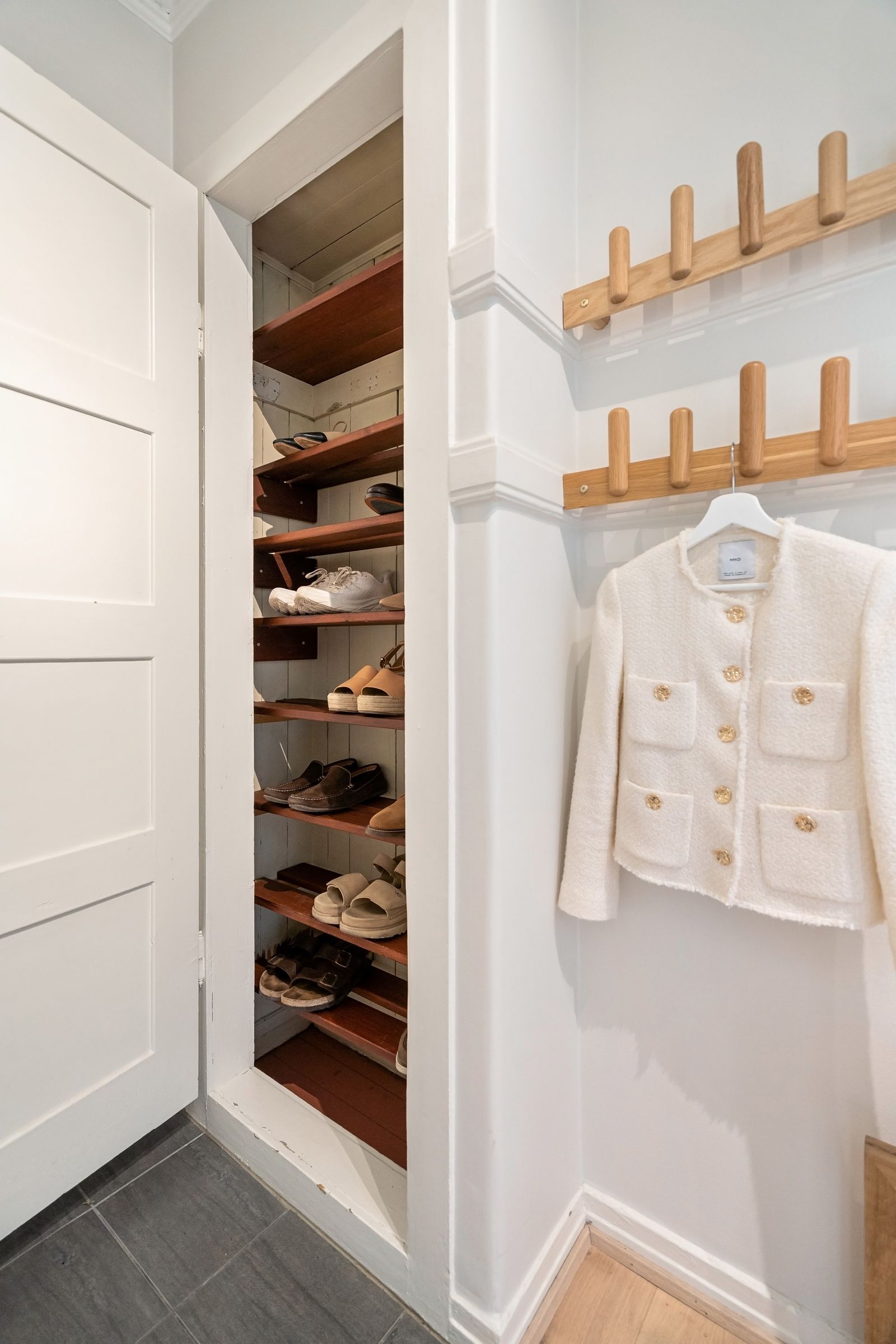
Zones: Give Everything a Place by Habit
The system that works long-term is zones: each person or category has a spot, and the spot is obvious enough that guests and children can use it without being told. A simple zone plan: hooks on the left for coats, a basket under the bench for shoes, a small bowl on the table for keys and coins, a hook or basket for bags, and a tray for incoming mail. When you come home, the routine is: coat on hook, shoes in basket, keys in bowl, bag on hook, mail in tray. Thirty seconds, done.
Children need zones at their height. A low hook they can reach, a basket they can toss shoes into, and a peg for their school bag turns tidying into something they can actually do, rather than a chore that requires adult help. Label baskets with pictures for younger children, or with names for older ones — ownership makes maintenance much more likely.
Small-Space Tricks That Actually Help
A mirror. A mirror on the wall opposite or beside the door reflects light and makes a narrow space feel larger. It is also genuinely useful for a last check before leaving. Choose one large mirror rather than several small ones, which can make a space feel cluttered.
Light colors and light. Pale walls, a light-colored bench, and a bright overhead light or wall lamp open up a dark hallway. If your entryway has no natural light, a warm, bright bulb makes a surprising difference — dark corners collect clutter because nobody looks at them closely.
One basket for "outgoing" things. Library books, parcels to return, items to take to a friend — these tend to pile on entryway surfaces. A single basket labelled for outgoing items contains them, and emptying it becomes part of leaving the house.
Seasonal rotation. Twice a year, swap the entryway's contents: winter coats, scarves and boots in; summer hats and sandals out, and vice versa. Store the off-season set in a closet or under a bed. An entryway that holds two seasons' worth of gear holds twice what it needs to, and that is usually why it fails.
These ideas connect naturally with the wider small-space thinking in our guide to small-space living ideas for a tiny home, and with the daily habit in our guide to a simple evening reset routine — the entryway check is the first minute of that routine. For the feeling of the space, our guide to budget-friendly cozy fall home ideas shows how a small rug, a plant, and warm light make an entryway welcoming without spending much.
What About Homes With No Entryway at All?
Many flats and small houses open directly into a living room, with no hallway to organize. The same system still works, scaled down: a row of hooks on the wall beside the door, a small tray for shoes by the door (a boot tray contains dirt and defines the boundary), and a tiny bowl or wall pocket for keys. The principle is identical — a defined place for arrival things, even if that place is one square meter of wall rather than a room.

Keeping It Working: The Two-Minute Evening Check
Systems fail quietly, one item at a time. The fix is a two-minute check each evening: shoes back in baskets, coats on hooks, mail dealt with or filed, and anything that does not belong carried to its real home. Tie it to something you already do — after dinner, or while the kettle boils — and it becomes automatic within a couple of weeks. Our guide to a simple evening reset routine for weeknights builds this check into a wider wind-down that makes mornings easier too.
Once a month, do a slightly longer reset: empty the baskets, wipe the surfaces, check for items that have crept in, and remove anything that has not been used in a month. Five minutes, once a month, prevents the slow return of the pile.
Frequently Asked Questions
How many shoes should live by the door?
One pair per person for daily wear, plus one shared spare pair for guests if space allows. Other shoes belong in bedrooms or closets. More than that, and the entryway becomes a shoe store.
What if several people share one small entryway?
Give each person one hook and one basket, and keep the system visible. When space is genuinely insufficient, store less-used coats and shoes elsewhere and keep only daily items by the door — the entryway serves the day, not the wardrobe.
Are shoe cabinets worth it?
Yes, especially slim tilt-out cabinets that hold several pairs in very little depth. They hide visual clutter, which makes a small space feel calmer, and they protect shoes from dust. Measure your largest shoes first — boots may need a taller section.
How do I stop mail piling up?
Give mail one tray and one rule: it is sorted the day it arrives. Junk goes straight to recycling, bills go to a single folder or spot, and anything needing action gets handled or dated within the week. A tray without a rule just becomes a prettier pile.
A small entryway does not need more space — it needs clearer decisions. Empty it, zone it, give everything one home, and let the two-minute check do the rest.



0 Comments
Play nice — spam and promo links are deleted.